What one electric-scooter charge looks like, read every two seconds
A Metrion unit logged one charge of an electric-scooter charger every two seconds. It drew about 730 W at a power factor close to 1.00 for 43 minutes, stepped down and tapered for an hour, then idled at about 7 W with a power factor of 0.25 for the 57 minutes the scooter stayed plugged in. The charge drew about 0.8 kWh.
Full write-up: download the PDF, with every source and figure.
What was measured?
A portable electric-scooter charger rated at up to 12 A output, 33–60 V DC, on a 170–270 V AC supply. One Metrion unit read its single-phase supply every two seconds for three and a half hours in September 2026, from plug-in to well after the charge finished.
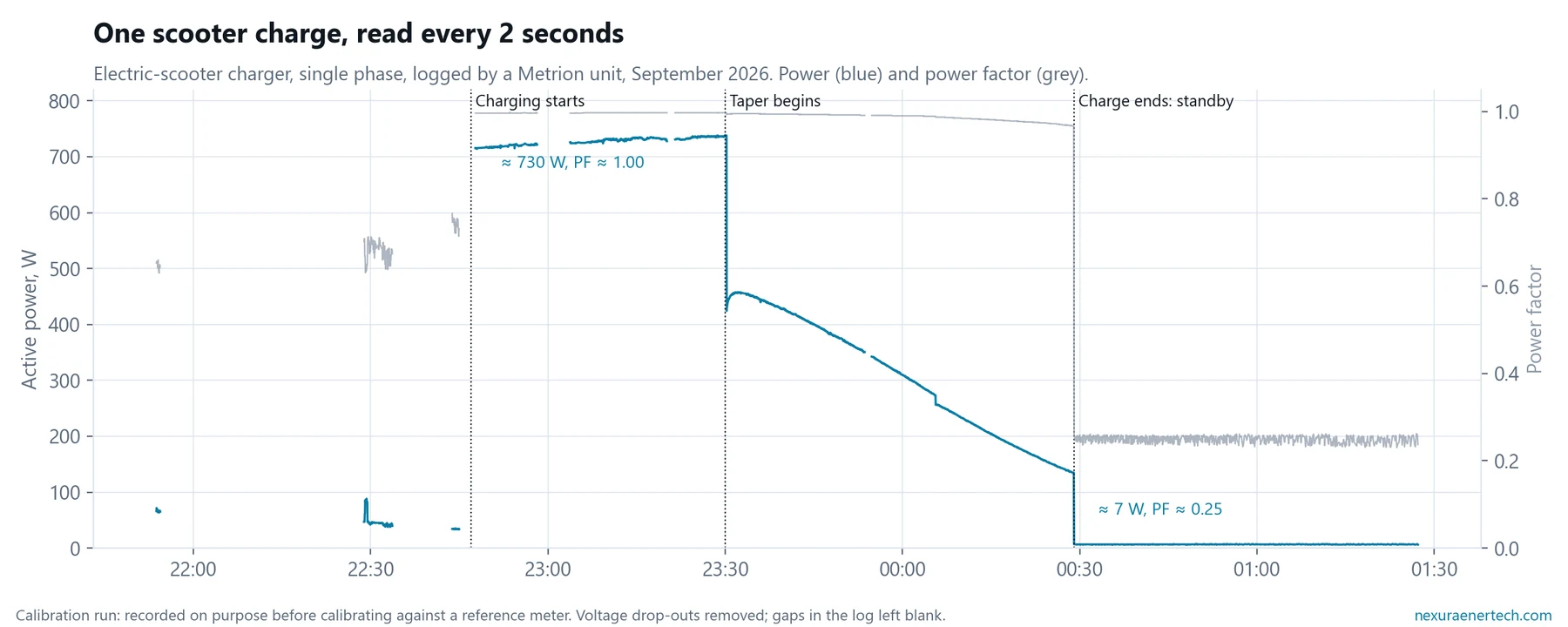
What does the charge look like?
| Stage | Time | What the meter saw |
|---|---|---|
| Full-power charging | 22:47–23:30 | About 730 W (≈ 3.05 A at ≈ 241 V), power factor ≈ 1.00 |
| Taper | 23:30–00:29 | A step down to about 455 W, then a smooth fall to about 135 W |
| Standby | 00:29–01:27 | About 7 W at power factor ≈ 0.25, scooter still plugged in |
The charge drew about 0.8 kWh from the supply: 0.81 kWh with the logger’s short drop-outs during charging (about 11 minutes) filled at the steady charging power, 0.72 kWh if they are left out. Measured as a bill would, kWh ÷ kVAh, the power factor while charging was 0.986.
How does power factor change with load?
| Load level | Average power factor | Share of readings |
|---|---|---|
| Full charge current (500–800 W) | 0.996 | 28% |
| Heavy (300–500 W) | 0.992 | 22% |
| Moderate (100–300 W) | 0.890 | 21% |
| Light (10–100 W) | 0.699 | 8% |
| Idle / standby (under 10 W) | 0.238 | 22% |
What is worth noticing?
- The highest draw is the first 45 minutes. For anyone charging several vehicles on one connection, that is when they add to demand.
- Clean while charging, poor when idle. A single monthly power-factor figure hides that a device’s power factor depends on what it is doing.
- An hour of bay time doing nothing. In a shared or fleet bay, a charge-complete alert would let the next vehicle start an hour sooner.
- Detail a bill cannot carry. A 30-minute demand block blurs the step at 23:30 into an average; a monthly bill loses it entirely.
What are the limits of this log?
- This was the calibration run. The meter’s own energy counter read zero and some voltage readings did not match, which is what the calibration then corrected. The energy figure above is worked out from the logged power, not read from that counter.
- About 9% of samples showed voltage drop-outs and were removed; the logger also had gaps, including about 22 minutes before charging began.
- One phase, one charger, one session.
Want to see this on your own panel?
Start with a free Bill X-ray: send your last three electricity bills and we return a written reading within two working days, with no obligation. If it shows something worth measuring, a 30-day paid pilot gives you a daily written review and a report reconciled to your next bill, and the fee counts towards your plan.
Get a free Bill X-ray